

If your hot water system has stopped working, or you can see it’s on its way out, one of the first questions I get asked is this: “Should I just replace it with the same thing, or is it worth upgrading to a heat pump?”
Honestly, it depends on your home, your energy setup, and what you’re trying to achieve. I’m Simon from SJS Plumbing, a licensed local plumber in Caroline Springs with over 21 years of experience installing and repairing hot water systems across Melbourne’s western suburbs, Caroline Springs, Tarneit, Truganina, Ravenhall, Deer Park, and beyond.
I’ve installed both systems hundreds of times. In this guide, I’ll give you my honest, practical take on heat pump vs electric hot water systems, what each one actually does, how they perform in Melbourne’s climate, what they cost to run, and which one I’d recommend for different types of homes.
No sales pitch. Just the facts.
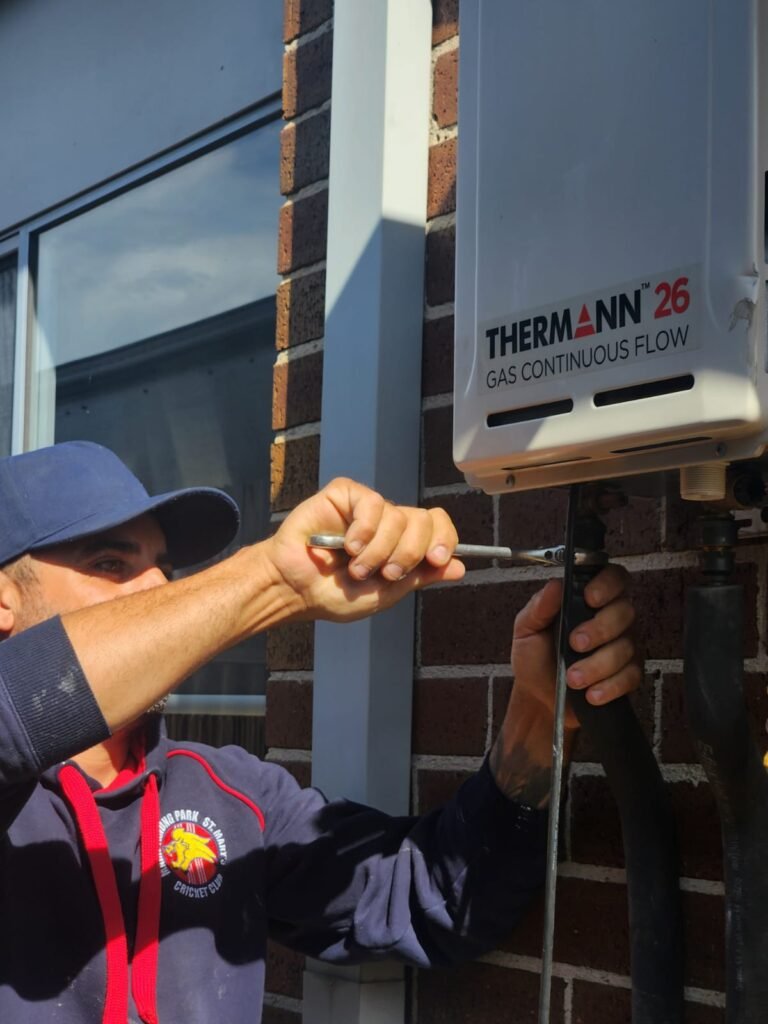
What Is a Standard Electric Hot Water System?
A conventional electric hot water system (sometimes called an electric resistance or electric storage system) works simply. It uses an electric heating element inside a storage tank to heat water directly, not unlike how a kettle works.
The water heats up, sits in an insulated tank (usually 125L to 315L, depending on household size), and stays at a temperature until you need it.
Main advantages of electric storage systems:
- Lower upfront purchase and installation cost
- Simple technology, fewer components, easier to repair
- Works anywhere, regardless of outdoor temperature or available space
- Smaller physical footprint, can fit in tight spots
Main disadvantages:
- High running costs. These are the most expensive hot water systems to operate on electricity
- Heating water directly from electricity is an inefficient process
- A typical household can spend $1,200 to $1,500 a year running one of these systems
- Not eligible for Victorian Government rebates on their own
- An electric storage hot water system is simple and reliable. But you pay for that simplicity on every quarterly electricity bill.
What Is a Heat Pump Hot Water System?
A heat pump hot water system is a fundamentally different piece of technology, and one that’s become the preferred choice for a lot of Melbourne homeowners in recent years.
Rather than generating heat directly from electricity, a heat pump pulls heat from the surrounding air using a refrigeration cycle, then transfers that heat into an insulated storage tank. Think of it like a reverse-cycle air conditioner working in reverse, but heating water instead of air.
The key advantage: heat pump systems typically use around 60 to 75% less electricity than a conventional electric hot water system, because the electricity powers the pump and fan rather than directly creating heat.
Main advantages of heat pump systems:
- Dramatically lower running costs. Typically $300 to $400 per year versus $1,200 to $1,500 for a standard electric system
- Eligible for Victorian Government rebates worth thousands of dollars
- Significantly lower greenhouse gas emissions
- Long hot water system lifespan. Quality units last 15 to 20 years.
- Pairs exceptionally well with rooftop solar panels
Main disadvantages:
- Higher upfront cost before rebates
- Needs adequate outdoor space for the unit and proper airflow
- Slightly more complex technology
- Performance can slow when outdoor temperatures drop very low. Modern units operate reliably down to -10°C, well below Melbourne’s coldest winter nights
Heat Pump vs Electric: Head-to-Head Comparison for Melbourne Homes
Here’s a straightforward comparison to help you understand the real-world differences:
| Feature | Standard Electric | Heat Pump |
| How it works | Direct electric element heats water | Extracts heat from ambient air |
| Efficiency | ~100% (1 unit of heat per 1 unit of electricity) | ~300% (3 units of heat per 1 unit of electricity) |
| Annual running cost (est.) | $1,200 – $1,500 | $300 – $400 |
| Upfront cost (before rebates) | Lower | Higher |
| After Victorian rebates | No rebates available | Rebates up to $2,700+ available |
| Outdoor space required | No | Yes, needs a ventilated outdoor area |
| Works with solar panels | Yes | Yes, pairs excellently |
| Lifespan | 8–12 years | 15–20 years |
| Melbourne winter performance | Unaffected | Reliable down to -10°C |
| Government rebate eligible | No | Yes. VEU + Solar Homes + STCs |
How Do These Systems Perform in Melbourne’s Climate?
This is one of the most common concerns I hear from homeowners in Caroline Springs while looking for a plumber in Caroline Springs. “Will a heat pump actually work properly in Melbourne winters?”
The short answer is yes, absolutely.
Modern heat pump hot water systems are rated to operate efficiently down to -10°C. Melbourne’s average winter overnight temperature sits around 5 to 7°C, well within that range. Even on Melbourne’s coldest nights, a quality heat pump keeps running without issue.
Some units have a boost element that activates in very cold conditions to make sure you never run out of hot water. If you’re running the system on a cheaper off-peak electricity tariff overnight, it needs to be sized correctly to cover your daily hot water needs. That’s something I assess properly when I come out to quote.
If you already have rooftop solar, a heat pump hot water system Melbourne installation is an even smarter combination. Setting a timer to run the system during the middle of the day, say 10 am to 4 pm, means it’s largely running on electricity your panels are already generating, cutting hot water system running costs down even further.
Victorian Government Rebates: The Game-Changer for Heat Pumps in 2026
Here’s what really shifts the numbers, and why I’m recommending heat pumps to almost every homeowner whose electric hot water system needs replacing right now.
Victorian homeowners can currently stack three separate rebate programs when upgrading to a heat pump hot water system:
1. Victorian Energy Upgrades (VEU) Program
The Victorian Energy Upgrades (VEU) program provides an upfront discount applied directly to your installation price, with no claiming after the fact. The discount is based on Victorian Energy Efficiency Certificates (VEECs) generated by your install, and historically, it’s ranged from hundreds to thousands of dollars off the total cost. Available to all Victorian homeowners and landlords.
2. Solar Victoria Hot Water Rebate
The Solar Victoria hot water rebate provides up to $1,000 off an eligible heat pump system, or up to $1,400 if you choose a locally made product.
Important: You need to apply for this rebate and receive your eligibility letter before installation starts. If the system goes in first, the rebate is forfeited. I flag this with every customer, and I can help guide you through the process.
3. Federal Small-Scale Technology Certificates (STCs)
The Federal Government’s scheme awards certificates for eligible heat pump hot water installations, applied as an upfront discount by your installer.
Combined, these three programs can reduce your upgrade cost by $2,000 to $2,700 or more, and in many cases bring the out-of-pocket cost close to zero.
My advice: before you commit to any hot water system installation in Caroline Springs or anywhere in the western suburbs, call me first. I can tell you within minutes whether your property is likely to qualify for the rebates and whether a heat pump makes sense for your situation.
Call me to check your eligibility: 0422 586 776
Which System Is Right for Your Home?
After 21 years of fitting hot water systems across Caroline Springs, Deer Park, Truganina, and surrounding suburbs, here’s how I think about this decision:
Choose a Heat Pump If:
- Your existing electric system needs replacing, and you want to cut running costs significantly
- You have a suitable outdoor area with at least 1 metre of clearance around the unit
- You want to take advantage of the current Victorian Government rebates
- You have or are planning rooftop solar panels
- You’re thinking long term. Heat pumps last longer and save more over time
- You want to reduce your household’s greenhouse gas emissions
Stick with a Standard Electric System If:
- Space is genuinely very limited, like a tight apartment with no outdoor area.
- Your system has failed as an emergency, and you need the fastest possible replacement with no rebate paperwork.
- Your budget requires the absolute lowest upfront cost with no flexibility
Even in those cases, I’d always suggest exploring the rebate options first. In many situations, a heat pump after rebates costs similar to or less than a standard electric hot water system replacement in Melbourne, and the running cost savings pay for any remaining difference quickly.
Real Running Cost Savings — What Does It Actually Mean for Your Bills?
Let me put this in plain numbers.
For a typical Melbourne household, switching from a standard electric system to a heat pump can reduce annual hot water system running costs by $600 to $900.
Over 10 years, that’s $6,000–$9,000 in electricity savings from a single upgrade decision.
If you combine a heat pump with a rooftop solar PV system, annual running costs can drop as low as $50–$100 per year, compared to $1,200–$1,500 for a standard electric system.
That’s the difference between heating your water for almost nothing versus paying a real ongoing electricity cost every single year.
What About Noise? A Question I Get Asked Often
Heat pump systems do produce some operational noise similar to a reverse-cycle air conditioner running outdoors. Modern units from quality brands have improved significantly in this area.
For most suburban homes in Caroline Springs, Tarneit, and Ravenhall, this isn’t an issue. I position the unit away from bedroom windows and neighbouring property lines during installation to keep any impact to a minimum. If noise is a concern for your specific setup, I’ll bring it up during the quote and recommend the quietest suitable model.
My Recommendation as a Local Plumber in Caroline Springs
After 21 years of doing this work, my honest take for most Melbourne western suburbs homeowners is this:
If your electric hot water system needs replacing, a heat pump is almost always the better long-term decision, especially right now while the Victorian Government rebates are in place.
The running cost savings are real. The rebates significantly reduce the upfront difference. The technology is proven and works well in Melbourne’s climate. And the units last longer.
The only time I recommend a straight electric replacement is when space, emergency timing, or budget genuinely make a heat pump impractical. I’ll always be upfront with you about which situation you’re in.
I install all major heat pump and electric hot water brands, including Rinnai, Rheem, Dux, Stiebel Eltron, and others. I’ll recommend the right unit for your household size and situation, not the most expensive one.
Call me to discuss your hot water system: 0422 586 776 Available 7 days, 10 am–10 pm
Book a Hot Water Assessment in Caroline Springs & Western Suburbs
If you’re seeing signs your hot water system is failing, ageing, or you’re simply thinking ahead, I’m happy to assess your current setup and give you an honest recommendation are heat pump or electric, whichever suits your home.
I service Caroline Springs, Tarneit, Truganina, Ravenhall, Deer Park, Taylors Hill, Hillside, Rockbank, and all surrounding western Melbourne suburbs.
Frequently Asked Questions
Is a heat pump hot water system worth it in Melbourne?
Yes, for most homes it is. A heat pump hot water system Melbourne uses 60 to 75% less electricity than a standard electric system, qualifies for a Victorian Energy Upgrades (VEU) rebate and other programs worth up to $2,700 or more, and lasts 15 to 20 years. The running cost savings make it a better long-term investment, especially for homes replacing an ageing electric storage hot water system.
Will a heat pump work properly during Melbourne winters?
Yes. Modern heat pump systems are rated to operate down to -10°C, and Melbourne’s winter temperatures rarely drop below 2–3°C overnight. Performance dips slightly in very cold conditions, but quality units maintain reliable hot water throughout Melbourne winters without issue.
What Victorian Government rebates are available for heat pumps in 2026?
Victorian homeowners can currently access three programs: the Victorian Energy Upgrades (VEU) discount applied upfront at installation, the Solar Victoria Hot Water Rebate of up to $1,000 (or up to $1,400 for locally made products), and Federal Small-Scale Technology Certificates (STCs). Combined, these can reduce your upgrade cost by $2,000–$2,700 or more.
How much does a heat pump save compared to a standard electric system?
For a typical Melbourne household, a heat pump hot water system can save $600–$900 per year in running costs compared to a conventional electric system. Over 10 years, that’s $6,000–$9,000 in savings, not including any additional benefit from pairing with solar panels.
Do I need outdoor space for a heat pump hot water system?
Yes. Heat pumps extract heat from the surrounding air and need adequate ventilation, typically at least 1 metre of clear space around the unit. They’re installed outdoors, similar to a reverse-cycle air conditioner’s outdoor unit. If your property has very limited outdoor access, I’ll assess whether a heat pump is practical during my initial visit.
Can I get a heat pump if I already have solar panels?
Yes, and it’s actually one of the best combinations. Setting your heat pump on a timer to operate during daylight hours (10 am–4 pm) allows it to run primarily on power generated by your solar panels, reducing running costs even further. Some households with solar pay as little as $50–$100 per year to heat their water.
How long does a heat pump hot water system last compared to electric one?
A quality heat pump hot water system typically lasts 15–20 years. Standard electric storage systems generally last 8–12 years. The longer lifespan adds to the long-term value of a heat pump, as you’re replacing it less often over 20 years.
Can I get the Solar Victoria rebate if my hot water system has already failed and I need emergency replacement?
If your system has failed and needs urgent replacement, Solar Victoria does allow you to install first and then apply for the rebate, but you must prove eligibility as soon as possible after installation and use only eligible products.Contact me before installation, if at all possible, so I can help you avoid missing out. If you need an emergency hot water plumber right now, call me directly on 0422 586 776.